What Oakville Parents Should Know Before Saying Yes to Treatment
Care Orthodontics Oakville
Evidence reviewed: October 14, 2026
A parent hears that their child has a narrow palate. An airway image appears on a screen. The conversation moves from crowded teeth to breathing, sleep and future health. Suddenly, an orthodontic decision feels much bigger than choosing how to straighten a smile.
That is where parents deserve especially clear answers.
The relationship between facial anatomy and breathing is worth investigating. So are the promises attached to treatment. When an appliance is recommended to address a dental problem, a breathing problem, or both, families should understand which benefit is established, which remains uncertain and how the result will be measured.
The question at the centre of this debate is whether a proposed airway benefit is strong enough to justify the treatment being offered.
This article examines the evidence behind airway orthodontics, the limitations of scans and the questions that can help families make an informed decision.
What does “airway orthodontics” mean?
In this article, airway orthodontics means an approach that considers breathing and sleep alongside the teeth, jaws and bite. Depending on the patient, the discussion may involve palatal expansion, appliances that position the lower jaw forward, or referral for medical investigation.
Those treatments have different purposes. Correcting a narrow upper jaw, improving nasal breathing and treating obstructive sleep apnea are separate outcomes. Evidence supporting one should not automatically be used to promise another.
The American Association of Orthodontists describes an important collaborative role: orthodontists can recognize possible symptoms, screen for risk, assess relevant dental and jaw features and work with medical clinicians when treatment is appropriate. Screening in the dental office does not independently establish a sleep apnea diagnosis.[13]
For families, the useful question is: “What exactly are we treating, and what evidence supports this treatment for someone like my child?”
Breathing problems deserve attention—but they need a diagnosis
Obstructive sleep apnea, or OSA, involves repeated partial or complete obstruction of the upper airway during sleep. These events can disrupt sleep and affect breathing and gas exchange. The condition has several contributing factors; jaw shape is only part of that picture. In otherwise healthy children, enlarged tonsils and adenoids are commonly important contributors.[2]
Parents should mention persistent loud snoring, witnessed breathing pauses, gasping, restless sleep, unusual sleeping positions or ongoing mouth breathing to a healthcare professional. Daytime attention or behaviour concerns can also be relevant to the history. These observations justify assessment; they do not identify the cause or prove that an orthodontic appliance is needed.[2]
An open-mouth photograph or a crowded dental arch cannot answer all the medical questions. Families deserve a process that investigates the concern before deciding on the solution.
Can a small airway on a scan diagnose sleep apnea?
No. An airway measurement alone cannot diagnose OSA.
A cone-beam computed tomography scan, or CBCT, can show anatomy and provide measurements of airway shape, area and volume. However, it usually captures an awake patient at one moment. Sleep-related obstruction is a dynamic event.
A 2024 review explains that an awake scan may miss obstruction occurring during sleep. Standing or sitting also differs from sleeping posture. CBCT does not measure the cardiorespiratory and neurological parameters needed to diagnose sleep-disordered breathing. The review also emphasizes that these scans use ionizing radiation and should have an individual clinical justification.[4]
That means a coloured airway image should be interpreted in context. It is reasonable to ask what the image contributes to the assessment and whether it changes the treatment plan.
Medical assessment and appropriate sleep testing answer different questions from a dental scan. In children, polysomnography—a sleep study—is an important diagnostic investigation. The AASM’s pediatric position paper does not recommend routine home sleep apnea testing for diagnosing OSA in children; adult testing pathways should not simply be transferred to younger patients.[3,13]
A scan can help describe anatomy. It cannot independently show how well a child breathes through an entire night.
Can palatal expansion help children with sleep apnea?
This is where the evidence becomes more nuanced.
Rapid maxillary expansion, also called rapid palatal expansion, is used to address a constricted upper jaw. Research has investigated whether it also improves sleep-related breathing in children with OSA and maxillary constriction.[6,7]
However, the patient group matters. Results from children who have both a confirmed sleep disorder and a narrow upper jaw should not be used to justify expansion for every child who snores, has crowded teeth or breathes through their mouth.
What the clinical guidance says
The 2024 American Thoracic Society guideline addresses children whose OSA persists after surgery to remove the tonsils and adenoids. It suggests that selected children with specific craniofacial features may be candidates for orthodontic or dentofacial orthopedic treatment.
Crucially, this is a conditional recommendation based on very low-certainty evidence.[5]
That wording matters. It allows consideration in a defined clinical situation while acknowledging substantial uncertainty. It does not establish expansion as routine treatment for all childhood sleep apnea.
What recent trials found
One commonly reported measure is the apnea–hypopnea index (AHI): the number of breathing pauses or episodes of reduced breathing per hour of sleep. A lower AHI is one way researchers track improvement.[6]
A 2024 randomized crossover trial involved 32 nonobese children with enlarged tonsils and maxillary constriction. Most improvement in sleep apnea measures was attributable to adenotonsillectomy. After accounting for other factors, palatal expansion generally had a marginal effect on the measured breathing outcomes.[6]
A separate 2025 randomized trial studied 24 children with both significant enlargement of the tonsils/adenoids and a narrow upper jaw. Both expansion and adenotonsillectomy improved several sleep-related outcomes over six months. The trial found no statistically significant difference between the groups in several sleep-study measures, while surgery produced greater improvement in symptoms and quality of life.[7]
The second study is encouraging for a possible role in selected patients. Nevertheless, a small trial finding no significant difference is insufficient to establish that the treatments are interchangeable. Its sample, follow-up and outcome definitions must all be considered.
Why the debate continues
A 2026 systematic review focused on controlled prospective studies and identified three newer randomized trials in addition to five studies previously reviewed. The authors highlighted the shortage of comparisons against observation or supportive care. The one available comparison with watchful waiting did not find a significant difference in apnea–hypopnea index changes between expansion and observation.[8]
This is an important methodological issue: improvement after treatment does not, by itself, tell us how much improvement the treatment caused. Growing children may change over time, and studies need suitable comparison groups to separate those effects.
The review urged considerable caution about recommending expansion specifically to treat pediatric OSA.[8] Its conclusion also illustrates why professional guidance and individual studies do not always sound equally optimistic.
The evidence supports careful discussion of patient selection and uncertainty. It does not support a universal promise that an expander will resolve a child’s sleep apnea.
Can early orthodontic treatment prevent future sleep apnea?
This is a different claim—and a much harder one to establish.
Treating a present dental problem or improving a current symptom is different from demonstrating that a child will avoid a sleep disorder years later. Prevention claims require research that follows suitable groups over time and measures whether the disease actually develops.
The 2026 AAO white paper update states that current evidence does not support orthodontic intervention preventing the development of sleep-disordered breathing.[1]
The implication for a family is practical. If future airway protection is offered as a reason to begin treatment, ask which studies demonstrate that preventive benefit and whether their patients resemble your child.
Early treatment may still be recommended for a specific orthodontic reason. The explanation should identify that reason and distinguish it from an unproven promise about future sleep health.
What about appliances that bring the lower jaw forward?
Appliances described as advancing or positioning the lower jaw should also be discussed according to their intended purpose. A recommendation for a bite problem and a recommendation for medically diagnosed OSA need different explanations and outcome measures.
For example, if an appliance is being offered partly for breathing, the family should ask whether the supporting study measured sleep-study outcomes, symptoms or only anatomical changes. They should also ask how its breathing effect will be evaluated in their own child.
The prevention conclusion in the 2026 AAO update remains relevant here: proposing an orthodontic intervention does not establish that it will prevent future sleep-disordered breathing.[1]
An informed conversation can acknowledge a possible benefit without turning that possibility into a guarantee.
Adult airway treatment is a separate conversation
Evidence and treatment pathways for adults should be considered separately from those for children.
Oral appliances for adult OSA
Custom oral appliances have a recognized role in adult sleep apnea care. The joint AASM/AADSM guideline recommends considering them for adults with OSA who cannot tolerate CPAP or prefer an alternative. It favours a custom, adjustable appliance when prescribed, dental monitoring for side effects and bite changes, and follow-up sleep testing to confirm effectiveness.[9]
A dental sleep appliance is therefore part of a coordinated treatment pathway. It should not be treated as equivalent to simply straightening the teeth with braces or clear aligners.
Expansion in selected adults
A prospective controlled study published in 2022 investigated mini-implant assisted rapid palatal expansion, or MARPE, in nonobese adults with OSA and transverse maxillary deficiency. The study enrolled 32 participants across treatment and control groups and reported improvements in breathing measures and quality of life in its selected population.[10]
Those findings are promising, but they are specific to that population and study design. They do not establish expansion as a general solution for adult sleep apnea. The paper also disclosed that one author held a patent relating to the expander used—relevant context when assessing the evidence.[10]
The 2024 AADSM consensus report noted that adult expansion studies involved patients with orthodontic transverse discrepancies, that residual sleep apnea could remain and that long-term durability was uncertain.[11]
The decision should explain both the dental indication and the sleep-care plan.
More expansion is not automatically better
An airway discussion should include the limits and risks of the proposed procedure.
The AADSM consensus report describes greater resistance to skeletal expansion in adults and the potential for unwanted tooth tipping, root resorption and cortical bone damage with unsuitable nonsurgical expansion approaches. Depending on the patient, skeletal anchorage or surgical assistance may be needed.[11]
These considerations reinforce a useful principle: treatment should have a defined target, a rationale and a stopping point.
Patients can ask how the clinician will distinguish movement of teeth from widening of the underlying jaw, how tissues will be monitored and what would lead to a change in the plan.
The relevant consent discussion should also cover the expected burden: appointments, appliance care, discomfort, cost and the possibility that the hoped-for breathing benefit may be smaller than expected. An uncertain benefit deserves to be discussed as uncertainty.
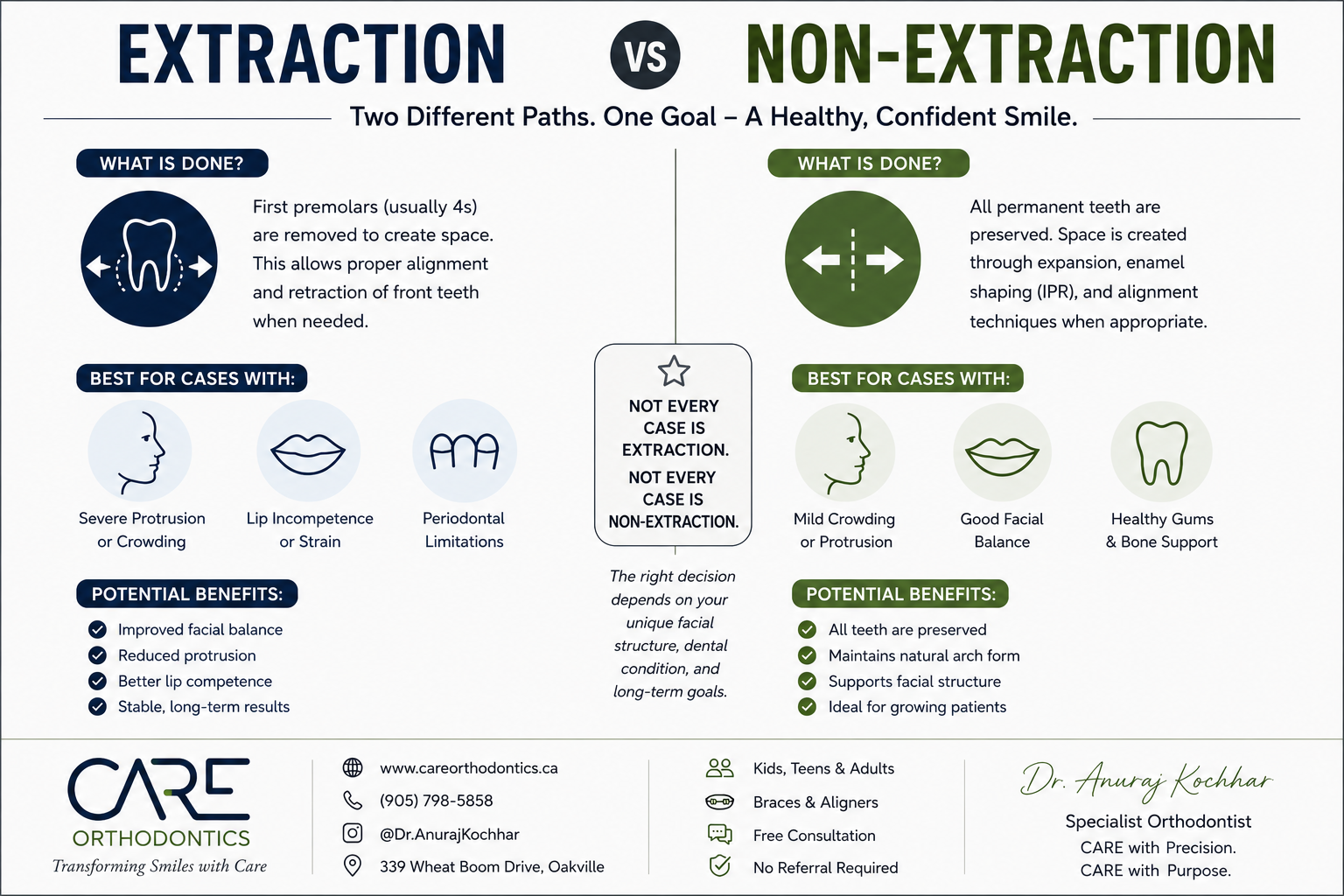
Do orthodontic extractions damage the airway?
Another claim sometimes connected to this debate is that removing premolars for orthodontic treatment inevitably harms breathing.
A 2025 systematic review comparing extraction and non-extraction treatment did not find evidence of an adverse average effect on the assessed upper airway volume and minimum cross-sectional area.[12]
Those are anatomical outcomes, however—not proof about every patient’s sleep or future OSA risk. The result should be interpreted within the outcomes actually studied.
This is another reason to ask for a treatment explanation specific to the patient. Decisions about extraction should not rest on a blanket claim that one approach always protects or always damages the airway.
How can parents tell a thoughtful recommendation from an overpromise?
A useful consultation should make the reasoning easier to follow. Parents should be able to identify the problem being treated, understand the alternatives and see how the proposed benefit will be assessed.
Consider these questions:
1. What is my child’s orthodontic diagnosis? What dental or jaw finding justifies the recommended appliance?
2. Is there a suspected sleep problem or a confirmed medical diagnosis? What assessment has established it?
3. What is the main goal? Bite correction, jaw width, symptoms and sleep-study results should be named separately.
4. What evidence supports this approach for a child like mine? Ask about age, anatomy, diagnosis and the length of follow-up.
5. What are the alternatives? What would medical evaluation, a different treatment sequence or appropriate monitoring involve?
6. How will success be measured? Who will arrange and interpret reassessment if sleep apnea is part of the treatment goal?
7. What happens if breathing symptoms persist? Ask who remains responsible for the sleep-care plan.
8. What are the risks, costs and uncertainties? These belong in the discussion before treatment begins.
Be particularly cautious about an absolute promise to prevent sleep apnea, a diagnosis based only on an airway image or a recommendation that cannot clearly explain why that individual patient needs the intervention.
These questions are intended to clarify a plan. A thoughtful clinician should welcome them.
What should happen when a child has both a bite problem and breathing concerns?
The family needs a coordinated explanation of both issues. A dental assessment can establish the orthodontic findings, while medical clinicians investigate the breathing concern and decide what testing or treatment is appropriate.[2,13]
If OSA persists after adenotonsillectomy, the ATS guideline provides one setting in which selected craniofacial findings may lead to consideration of orthodontic treatment.[5] That context should remain clear rather than being broadened into a recommendation for every child.
Before starting, the family should know which clinician is handling each part of the plan, which outcome is expected from each intervention and when the results will be reviewed.
For adults receiving an oral appliance for OSA, the AASM/AADSM guideline specifically recommends follow-up sleep testing and continuing dental and sleep-clinician review.[9] The same underlying question is useful in any airway discussion: “How will we know whether the breathing problem has actually improved?”
A better conversation about airway orthodontics
Families should not have to choose between ignoring a possible breathing problem and accepting every proposed airway treatment.
They deserve careful assessment, a clear diagnosis, treatment choices explained in ordinary language and honest discussion of the evidence. They also deserve to hear when a claim is promising but not established.
Airway orthodontics becomes a more useful conversation when the goals are specific and the outcomes can be checked. The debate should encourage that standard of care.
For Oakville families considering expansion, braces or other orthodontic treatment, ask for a plan that explains the dental indication and the evidence behind any additional breathing claims. Contact Care Orthodontics Oakville to discuss your orthodontic questions, and bring ongoing sleep or breathing concerns to your child’s medical clinician as well.
This article provides general education. Treatment choices depend on an individual orthodontic and, when relevant, medical assessment.
References
1. Palomo JM, Cohen-Levy J, Flores-Mir C, et al. Sleep-disordered breathing and orthodontics: An American Association of Orthodontists white paper update. American Journal of Orthodontics and Dentofacial Orthopedics. 2026;169(4):419–427. doi:10.1016/j.ajodo.2026.01.014. PubMed.
2. American Academy of Pediatric Dentistry. Policy on Obstructive Sleep Apnea (OSA). The Reference Manual of Pediatric Dentistry. 2025:145–148. Latest revision 2021. Policy PDF.
3. Kirk V, Baughn J, D’Andrea L, et al. American Academy of Sleep Medicine Position Paper for the Use of a Home Sleep Apnea Test for the Diagnosis of OSA in Children. Journal of Clinical Sleep Medicine. 2017;13(10):1199–1203. doi:10.5664/jcsm.6772. PubMed.
4. Savoldi F, Dagassan-Berndt D, Patcas R, et al. The use of CBCT in orthodontics with special focus on upper airway analysis in patients with sleep-disordered breathing. Dentomaxillofacial Radiology. 2024;53(3):178–188. doi:10.1093/dmfr/twae001. Full text.
5. Ehsan Z, Ishman SL, Soghier I, et al. Management of Persistent, Post-adenotonsillectomy Obstructive Sleep Apnea in Children: An Official American Thoracic Society Clinical Practice Guideline. American Journal of Respiratory and Critical Care Medicine. 2024;209(3):248–261. doi:10.1164/rccm.202310-1857ST. PubMed.
6. Magalhães MC, Normando D, Soares CJ, et al. Impact of adenotonsillectomy and palatal expansion on the apnea-hypopnea index and minimum oxygen saturation in nonobese pediatric obstructive sleep apnea with balanced maxillomandibular relationship: A cross-over randomized controlled trial. Pediatric Pulmonology. 2024;59(12):3507–3517. doi:10.1002/ppul.27239. PubMed.
7. Aksilp C, Pechpongsai P, Intakorn P, et al. A randomized controlled trial comparing treatment efficacy between rapid maxillary expansion and adenotonsillectomy in pediatric obstructive sleep apnea. Sleep and Breathing. 2025;29:256. doi:10.1007/s11325-025-03427-8. Full text.
8. Fernández-Barriales M, López de Luzuriaga M, Lafuente-Ibáñez de Mendoza I, et al. Controlled Prospective Evidence of Rapid Maxillary Expansion Efficacy in Pediatric Obstructive Sleep Apnea: A Systematic Review Update. Journal of Clinical Medicine. 2026;15(8):2976. doi:10.3390/jcm15082976. PubMed.
9. Ramar K, Dort LC, Katz SG, et al. Clinical Practice Guideline for the Treatment of Obstructive Sleep Apnea and Snoring with Oral Appliance Therapy: An Update for 2015. Journal of Clinical Sleep Medicine. 2015;11(7):773–827. doi:10.5664/jcsm.4858. PubMed.
10. Brunetto DP, Moschik CE, Dominguez-Mompell R, Jaria E, Sant’Anna EF, Moon W. Mini-implant assisted rapid palatal expansion (MARPE) effects on adult obstructive sleep apnea (OSA) and quality of life: a multi-center prospective controlled trial. Progress in Orthodontics. 2022;23:3. doi:10.1186/s40510-021-00397-x. PubMed.
11. Sheats R, Masse JF, Levine M, et al. Novel Therapies for Preventing, Managing and Treating Obstructive Sleep Apnea and Snoring in Pediatric and Adult Patients. Journal of Dental Sleep Medicine. 2024;11(2). doi:10.15331/jdsm.7332. Consensus report PDF.
12. Papageorgiou SN, Zyli M, Papadopoulou AK. Extraction of premolars in orthodontic treatment does not negatively affect upper airway volume and minimum cross-sectional area: a systematic review with meta-analysis. European Journal of Orthodontics. 2025;47(2):cjaf012. doi:10.1093/ejo/cjaf012. PubMed.
13. American Association of Orthodontists. Can Orthodontic Treatment Help Sleep Apnea? Patient information. Accessed October 14, 2026.