# Invisalign vs Braces: Which Is Better for Adults in Oakville?
For many adults considering orthodontic treatment, one of the biggest questions is simple: should you choose Invisalign or traditional braces?
The answer is not always straightforward.
At Care Orthodontics, we believe orthodontic treatment is not something you simply “buy.” Every smile, bite, jaw relationship, and facial profile is biologically unique. Treatment planning involves biomechanics, bone biology, facial balance, airway considerations, and long term stability.
That is why two patients with seemingly similar crowding may require completely different treatment approaches.
So which option is better for adults in Oakville: Invisalign or braces?
Let us break it down.
## Why More Adults Are Choosing Orthodontic Treatment
Adult orthodontics has become increasingly popular in recent years. Many adults are now seeking treatment not only for cosmetic reasons, but also because of:
• Bite problems
• Teeth shifting over time
• Difficulty cleaning crowded teeth
• Jaw discomfort
• Wear on teeth
• Smile confidence
• Professional appearance
Modern orthodontics offers more discreet and comfortable options than ever before, making treatment much easier to integrate into adult lifestyles.
## What Is Invisalign?
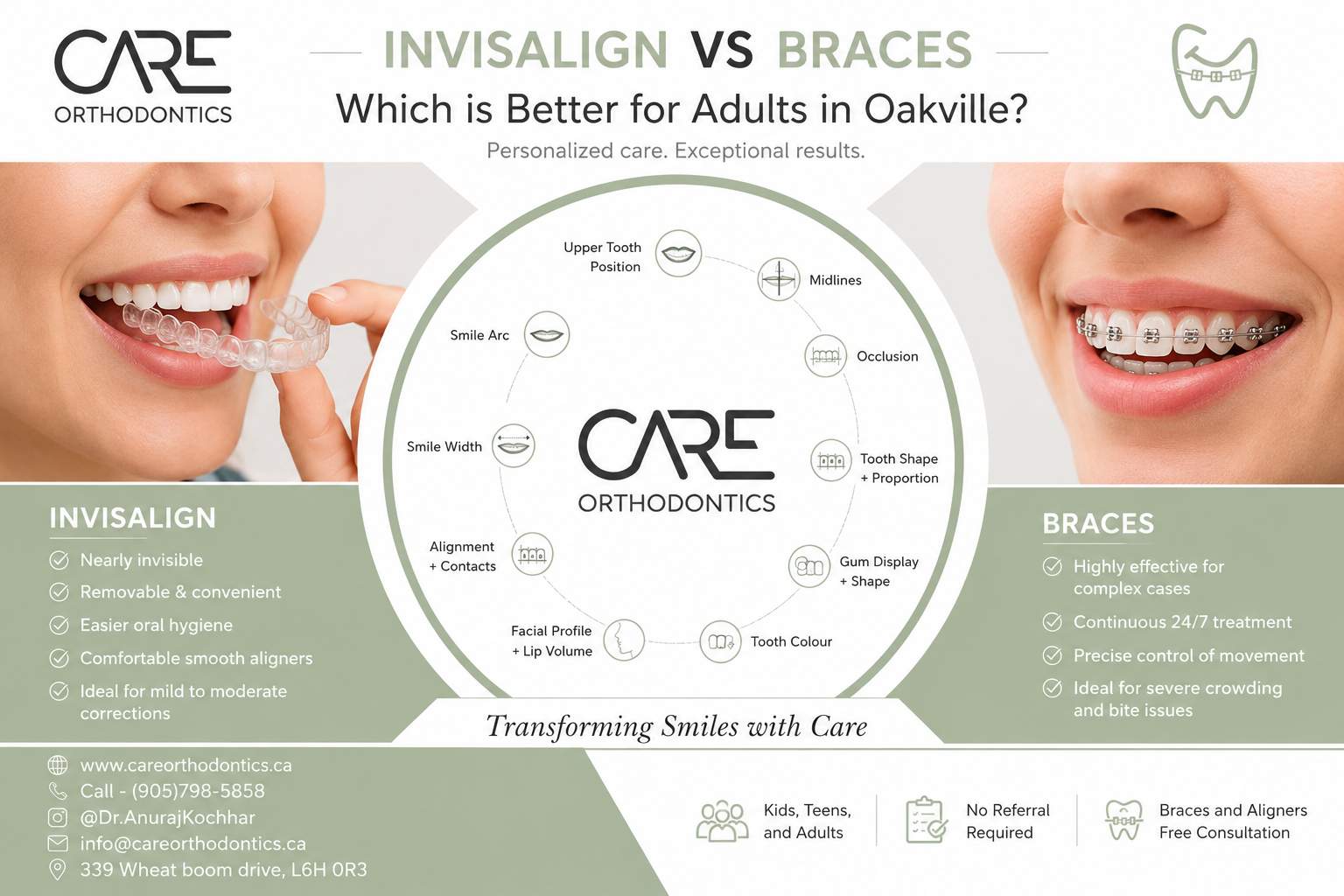
Invisalign uses a series of clear removable aligners designed to gradually move teeth into better positions. These aligners are custom fabricated using advanced digital scanning and treatment planning.
Invisalign can be highly effective for many orthodontic problems, including:
• Mild to moderate crowding
• Spacing
• Overbite correction
• Crossbites
• Relapse after previous braces
• Cosmetic smile improvements
One of the biggest advantages of Invisalign is aesthetics. Many adult patients appreciate the nearly invisible appearance of the aligners during professional and social interactions.
Invisalign also allows patients to remove the aligners while eating and brushing, making oral hygiene easier compared to traditional braces.
## What Are Traditional Braces?
Braces use brackets and wires to apply continuous forces to teeth. Modern braces are far smaller and more comfortable than older systems many adults remember from childhood.
Braces remain one of the most powerful and precise orthodontic tools available, especially for more complex cases involving:
• Significant crowding
• Rotated teeth
• Severe bite discrepancies
• Vertical problems such as open bites
• Cases requiring extractions
• Complex tooth movements
Because braces are fixed to the teeth, they work continuously without relying heavily on patient compliance.
## Invisalign vs Braces: The Real Difference
The biggest misconception is that Invisalign and braces are simply “different products.”
They are actually different biomechanical systems.
Some tooth movements are easier with aligners. Others are more predictable with braces. Successful treatment depends heavily on diagnosis and planning, not just the appliance itself.
At Care Orthodontics, every adult orthodontic consultation includes evaluation of:
• Facial profile
• Smile arc
• Bite relationship
• Jaw position
• Bone support
• Gum health
• Airway and functional considerations
• Long term stability
In some adults, Invisalign may achieve excellent results efficiently and discreetly. In others, braces may provide greater precision and control.
Sometimes, a combination approach may even be recommended.
## Are Braces Faster Than Invisalign?
Not necessarily.
Treatment duration depends more on the complexity of the case and patient compliance than the appliance itself.
However, Invisalign success depends heavily on wearing aligners consistently, typically 20 to 22 hours per day. Adults with demanding schedules or inconsistent wear habits may experience slower progress.
Braces continue working around the clock because they are fixed to the teeth.
## What About Comfort?
Both systems involve an adjustment period.
Invisalign patients often report smoother comfort overall because there are no brackets or wires rubbing against cheeks and lips. However, aligners can still create pressure as teeth move.
Braces may initially cause more irritation, particularly after adjustments, but many patients adapt quickly.
## Which Option Looks Better?
For aesthetics alone, Invisalign is usually preferred by adults.
That said, modern braces are much more refined and discreet than older designs. Some adult patients actually prefer braces because they do not need to worry about removing aligners for meals, coffee, or social events.
The “best” option depends on lifestyle, goals, and the specific orthodontic problem being treated.
## Why Specialist Orthodontic Treatment Matters
Orthodontics is far more than straightening teeth.
The same appliance can produce dramatically different outcomes depending on diagnosis, biomechanics, and treatment planning.
At Dr. Anuraj Kochhar, treatment planning focuses not only on alignment, but also on facial harmony, bite function, periodontal health, and long term stability.
Every case is approached individually because no two smiles are biologically identical.
## Final Thoughts
There is no universal winner between Invisalign and braces.
The right choice depends on your bite, facial structure, goals, compliance, and the complexity of tooth movement required.
For some adults, Invisalign offers an elegant and discreet solution. For others, braces provide the control needed for more comprehensive correction.
The most important decision is not choosing the appliance.
It is choosing the right orthodontic diagnosis and treatment plan.
If you are considering orthodontic treatment in Oakville, a consultation with a specialist orthodontist can help determine which option is best suited to your smile and long term oral health.